Species Library · Highland Botanicals
Prinsepia utilis Royle
Rosaceae · Genus Prinsepia · a woody oil plant of the highlands. This dossier is maintained under Identity — Habitat — Phenology — Chemistry — Evidence — Known/Unknown; last verified on 3 September 2026.
Botanical Identity
| Scientific name | Prinsepia utilis Royle (1835), Ill. Bot. Himal. Mts. 206. |
|---|---|
| Family / Genus | Rosaceae / Prinsepia |
| Local Chinese names | Qingci Guo (青刺果), Qingci Jian (青刺尖) |
| English common names | Himalayan prinsepia / Royle's prinsepia; local trade name "Green Thorn Fruit" |
| Used parts | Fruit (pressed for oil), young shoots and leaves (food), traditionally documented medicinal uses |
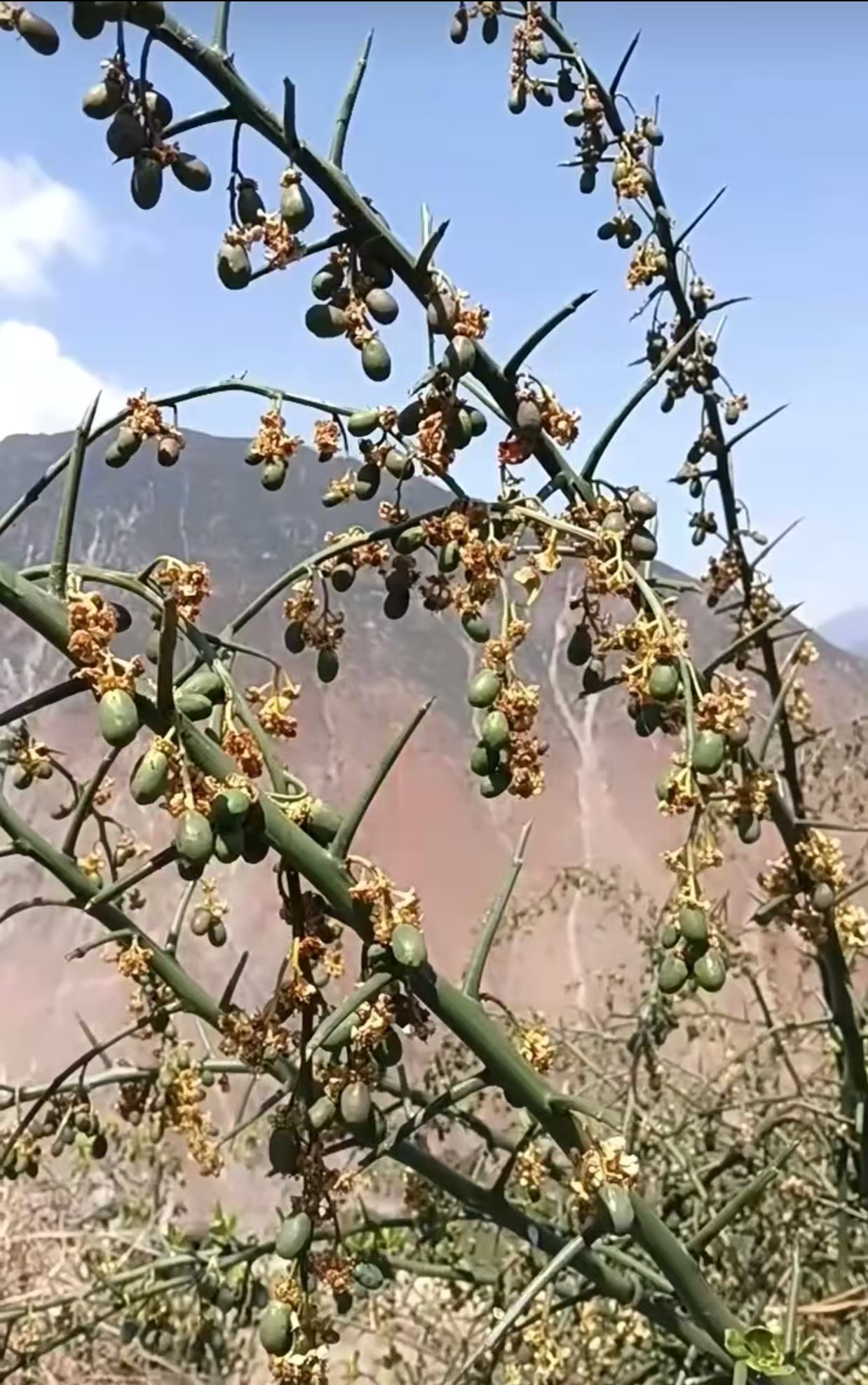
| Habit | Deciduous shrub 1–5 m; spiny branches; small flowers from deep winter to early spring; drupes ripening one by one from green to purple-red. |
Morphology per Flora of China and literature; measured field records from our producing area are being accumulated.
Distribution & Phenology
Where it grows & its year
Literature places P. utilis in southwestern China (Yunnan, Xizang/Tibet, Sichuan, Guizhou) and the Himalaya (Nepal, northern India, Pakistan, Bhutan), mostly 1,000–3,100 m in scrub, forest margins and valley sides. Within Yunnan it is documented across northwest Yunnan (e.g. Lijiang/Yongsheng, Yulong) — species range ≠ our cooperative's producing area; we speak only for our own batches.
Phenology: blooms in deep winter ("small, unremarkable flowers in the cold winter"); fruits set in spring and ripen berry by berry in summer–autumn — hence repeated hand-picking.
Chemistry (E1)
What it contains
Chemical figures are reported study-by-study and batch-by-batch. "Similar to human sebum" is a static compositional description in a review — not itself evidence of skincare benefit.
Known
- Identity is clear: taxonomy and morphology are documented in authoritative floras (E1)
- Long traditional use history, incl. the Diannan Bencao record (E0)
- In-vitro models show moisturizing and antioxidant activity; fatty-acid profile is well characterized (E1/E2)
- Ethnobotanical survey: 840 interviewees across 6 ethnic communities in NW Yunnan (E0, Guihaia 2023)
Unknown / to be verified
- No published human clinical studies (E4 gap)
- Routine third-party testing records for our own batches are under construction
- Food-use approval and international certification status not yet verified
- Local phenology & ecological baselines need at least one full year of records
- Naxi tradition: before a child is born, the grandmother climbs high into the mountains to find Prinsepia utilis; ripe berries are hand-picked one by one, peeled, washed in spring water, sun-dried and pressed into oil — "the treasure oil of the Naxi people".
- Traditional culinary use: a few drops added to cooking, soup or salads (always in moderation).
- Traditional topical use in the dry season; the Diannan Bencao records "Qingci Jian… treats swellings and sores" (quoted verbatim for research reference only).
- We continue to document these uses with images and notes in the field archive (see Highland Journal, Chinese).
Downloads